Products
RFID Tags for All Applications & Environments
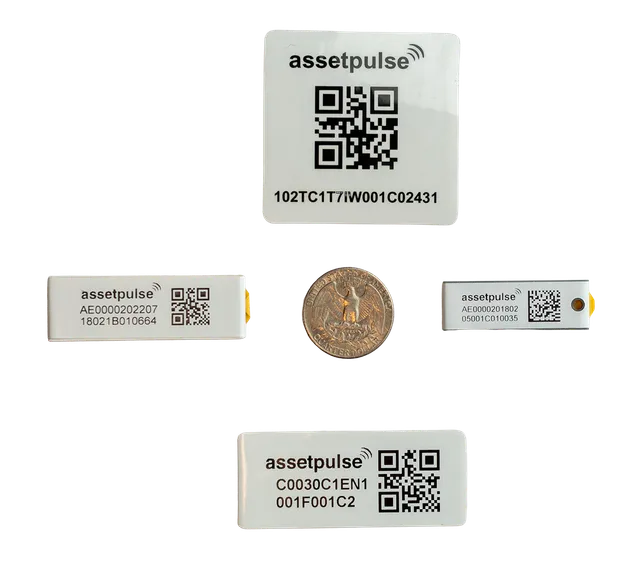
RFID tags are the foundation of any asset tracking system. Whether you’re tracking lab equipment, IT assets, tools on a manufacturing floor, or pipelines in the field, the right tag makes all the difference. AssetPulse helps you select, test, and deploy tags optimized for your specific environment and use case.
Technology
How RFID Tags Work
An RFID reader emits radio waves through its antenna. When a tag enters the field, the tag’s antenna captures the electromagnetic energy, which powers the integrated circuit. The IC then modulates and sends its stored data back through the antenna to the reader — all in milliseconds, with no line-of-sight required.
Anatomy
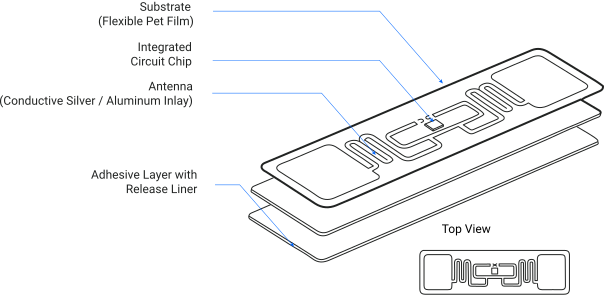
Three Core Components
Antenna
Receives and transmits RF signals between the tag and the reader. In passive tags, the antenna also harvests energy from the reader’s radio waves to power the chip.
Integrated Circuit (IC)
The logic unit that manages memory allocation, data storage, and anti-collision protocols — allowing multiple tags to be read simultaneously without interference.
Substrate
The base material that holds the antenna and IC together. Typically made from polymers, PVC, styrene, polyester, or paper depending on the application.
Tag Types
Label & Inlay vs. Hard Tags
Label & Inlay Tags
Thin, flexible, and under 1 gram. Inlays are transparent; labels add a printable surface. The most cost-effective option for high-volume deployments on smooth surfaces.
Hard Tags
Rigid enclosures made from ceramic, ABS, steel, polycarbonate, or polypropylene. Heavier (0.2 g to 250 g+) but built to survive extreme conditions — impacts, chemicals, high temperatures, and outdoor exposure.
Best Practices
Tag Positioning
Size
Larger tags produce a longer read range due to a bigger antenna surface area.
Orientation
Whether the tag is mounted vertically or horizontally relative to the reader antenna significantly affects read rates.
Angle
Steep angles between the tag and reader antenna reduce read range. Even slight angle changes can affect performance.
Placement
Tags should be tested facing the reader antenna for optimal results. Nearby metal or liquids can detune the antenna.
Attachment
Factors for Tag Attachment
Surface Area
Must be smooth, clean, and free of dust and moisture for adhesive-backed tags.
Exposure
Tags exposed to moisture, chemicals, vibration, or UV light need specialized attachment methods and enclosures.
Temperature
Attachment materials must withstand the environment’s temperature extremes without degrading.
Lifespan
The durability of the attachment method must match or exceed the expected lifecycle of the tagged asset.
Specialized Tags
Tags Built for Harsh Environments
AssetPulse offers a range of specialized tags engineered for the most demanding conditions — from autoclave cycles in labs to outdoor exposure on construction sites.
- ✓Extreme temperature resistance
- ✓Metal-mountable variants
- ✓Printable labels & inlays
- ✓Embeddable designs
- ✓Shock, vibration & impact resistance
- ✓Customizable colors, graphics & text
- ✓Autoclavable (sterilization-safe)
- ✓UV-resistant
- ✓Chemical-resistant
Frequently Asked Questions
Related Solutions
See it in action



Related Reading
Go deeper
- Mastering RFID Tag Placement: Your Guide to Flawless Asset Tracking
- Maximizing RFID Tag Read Range: A Complete Guide for Reliable Asset Tracking
- Passive RFID Tags: The Complete Guide to Types, Read Ranges, and Use Cases
- Active vs Passive RFID: Choose the Right Technology for Your Needs
- RFID Frequency Ranges – How to Choose the Right Frequency & Tag
- How RFID Tags for Inventory Help Achieve Real-Time Visibility and Control
Need help choosing the right tags?
Our team will recommend and test the optimal tags for your environment, surface materials, and read-range requirements.